The Watch · Resources
Water & Power
What a frontier AI campus actually draws from a desert — measured honestly. The figures below come from primary sources only: operator disclosures, federal laboratories, the International Energy Agency, and the permit record. Where the technology is genuinely efficient, this page says so. Where the numbers don’t close, it says that too.
01The scale of the thing
Data centers used about 4.4% of all US electricity in 2023 — federal researchers project 9–13% by 2028. Globally, demand is on track to more than double by 2030, to roughly the annual consumption of Japan. Project Jupiter’s filed application asks for up to 2.45 gigawatts of on-site generation — more electricity than the entire city of El Paso uses.
02The water question, reconciled
Every number in this table is real. They describe different water.
Two qualifications the record insists on: the county cap covers potable water only — the word “potable” was added to the agreement after the commission vote — and the State Engineer’s ~1M figure is a working estimate its own office traces to an informal conversation with a Project Jupiter attorney, not a metered measurement. The numbers are not directly comparable, and this page does not compare them as if they were.
| Category | Figure | Status |
|---|---|---|
| Potable (office) water — the county cap | 20,000 gal/day avg · 60,000 max | Legally capped — but only the potable water |
| Cooling-loop fill (one-time, all four buildings) | ~10,000,000 gal | Oracle’s own figure — 2.5M per building, over 2–3 years. CORRECTED Sep 12 2026: this row read 960,000. |
| Fuel-cell fill (one-time) | 960,000 gal | Oracle’s own figure — this is the number we had on the wrong row |
| Fuel-cell operating water | 0 | Manufacturer spec — credible |
| Total demand, State Engineer calculation | ~1,000,000 gal/day | ~50× the county figure — non-potable water is uncapped |
The gap is not a measurement dispute — it’s a definition. The agreement’s cap gained the word “potable” after the vote, so the industrial well water bought from a Sunland Park rights holder, the construction draw, and everything non-potable sit outside it. Confronted with the State Engineer’s number, the county attorney first called it misinformation — then conceded: “Quite frankly, we just don’t have enough information.”
The right itself is now identified: OSE file LRG-03150-E — 2,400 acre-feet a year, held by Santa Teresa Capital, LLC, its permitted purposes already covering industrial use. The campus demand would consume roughly half of it. The emergency filing itself, read in full: three wells had already failed, not one, and the industrial project’s construction schedule is listed among the reasons. One correction this record owes: the action box on that application form is blank, and this page previously concluded from that no approval had issued. An authorization did issue, dated October 23, 2025 — named in the Supreme Court order that stayed it on August 23, 2026. Under § 72-12-22 drilling proceeds during review, which remains true; the inference that nothing had been approved does not. Protests — including the Center for Biological Diversity’s, filed on the January 9 deadline — await a hearing with no docketed date. This record has counted thirty-two of them; the State Engineer told Congress in August 2026 that thirty are on file. Neither figure has been withdrawn and we have not reconciled them.
And now there is a meter reading. Every water figure on this page until this point has been a projection — a permitted right, a modeled demand, an estimate with its provenance argued over. The State Engineer’s own public meter record for the new well shows 318.001 acre-feet drawn between April 14 and July 31, 2026. That is 103,620,944 GALLONS. Not authorized. Pumped — and the meter is the state’s, readable by anyone at nmwrrs.ose.nm.gov.
Two things about that number, and the second one is in the applicant’s favor. Annualized, 318 acre-feet across those 109 days runs to roughly 1,065 acre-feet a year — about 44% of the 2,400-acre-foot right, and close to the “roughly half” this page has projected all along. The pumping is within the right. The dispute is not that too much water was taken; it is whether the process that authorized taking it was the one the law requires.
Nine days before the meter reading reached this record, Oracle announced a water program. On August 11, 2026 it entered a partnership with the agricultural-technology company Arable to fund irrigation-efficiency work in the Rio Grande–Bravo watershed — the same watershed that serves the campus — conserving, it says, about 21 million gallons a year. In Oracle’s own words the figure is “more than 20 times the amount of water needed to run Project Jupiter’s cooling and power systems, and more than the campus’s total potable and non-potable consumption combined at peak employment.” The company also says an independent third-party assessor will validate the savings, and that it will publish the validation reports.
Both figures are primary-source and both are true, and they are measuring different things. Work Oracle’s ratio backward and the operational number it compares against is roughly a million gallons a year; the same release puts fifteen years of campus use, initial fill included, at about what nine single-family homes consume. The meter shows 103,620,944 gallons in 109 days. That is on the order of seven times the entire fifteen-year operational figure, drawn in under four months. There is no contradiction: Oracle is describing operations and a one-time fill, and the State Engineer’s meter is measuring construction. That is precisely the point worth holding onto — construction water is not inside Oracle’s number, and construction water is what is before the Supreme Court.
The validation reports are the test. An unnamed assessor, an unnamed methodology and no publication date are what the promise contains today; a published report with a named assessor is what would turn 21 million gallons from a projection into a measured figure — the same distinction this page just drew for the well. This record will look for it.
Two weeks later Oracle published the breakdown, and it is worth putting down in full because it is the first accounting that covers both the four buildings and the fuel cells at once. About 10 million gallons to fill the four closed-loop cooling systems — 2.5 million each. About 960,000 gallons for the fuel cells’ initial fill. Roughly 11 million gallons of one-time fill in all. After that, about 168,000 gallons a year: cooling top-offs Oracle puts between zero and 1,000, plus the 167,000 Bloom Energy has stated for fuel-cell maintenance. That is about 457 gallons a day. Fifteen-year total: about 13.5 million gallons, all non-potable. County Commission Chair Manuel A. Sanchez pointed a reporter to the document; the figures are Oracle’s estimates and the outlet that published them is still awaiting answers to its follow-up questions.
Read that against what this page derived above and the derivation holds — 13.5 million gallons is what “about nine single-family homes over fifteen years” works out to. So the arithmetic is not in dispute, and one framing is worth watching. Oracle also states the same total as “roughly 900,000 gallons per year,” which takes the one-time 11-million-gallon fill and spreads it mathematically across all fifteen years. It is the same water described two ways, and only one of the two numbers — 168,000 a year, 457 gallons a day — is an amount actually drawn in a given year. Neither is the construction figure. The meter reading above still stands alone in that respect: 103,620,944 gallons in 109 days, and no fifteen-year framing reaches it.
An argument against this page, from a network that spent a broadcast on data-center backlash. In September 2026, 60 Minutes reported: “A CBS News analysis found golf courses nationwide use more than twice as much water as data centers.” It is the second time this framing has reached these pages from CBS. It is true, and it belongs here.
The answer is the same one this page has always given, and it is not about volume. Project Jupiter’s water case has never rested on what data centers use nationally. It rests on one aquifer under a federal consent decree requiring 18,200 acre-feet a year of reduced depletion; on a 2,400-acre-foot right that is 13.2% of that obligation; on an emergency authorization the Attorney General argued was unlawful for want of a showing the agency’s own guidance requires; on a protest that went ten months without a hearing; and on a meter reading of 103,620,944 gallons in 109 days. Golf courses are not the comparison. The basin is.
September: the Attorney General files against the State Engineer
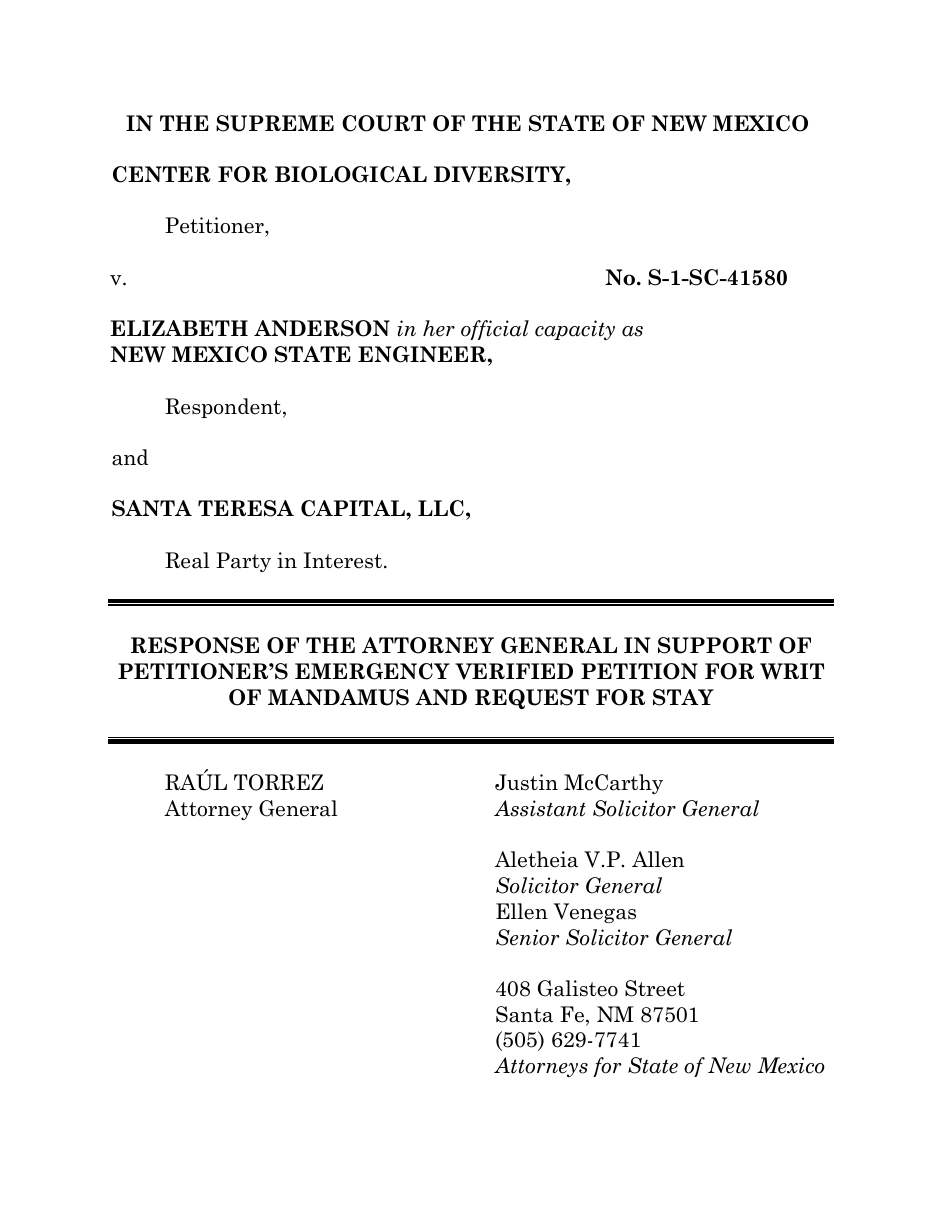
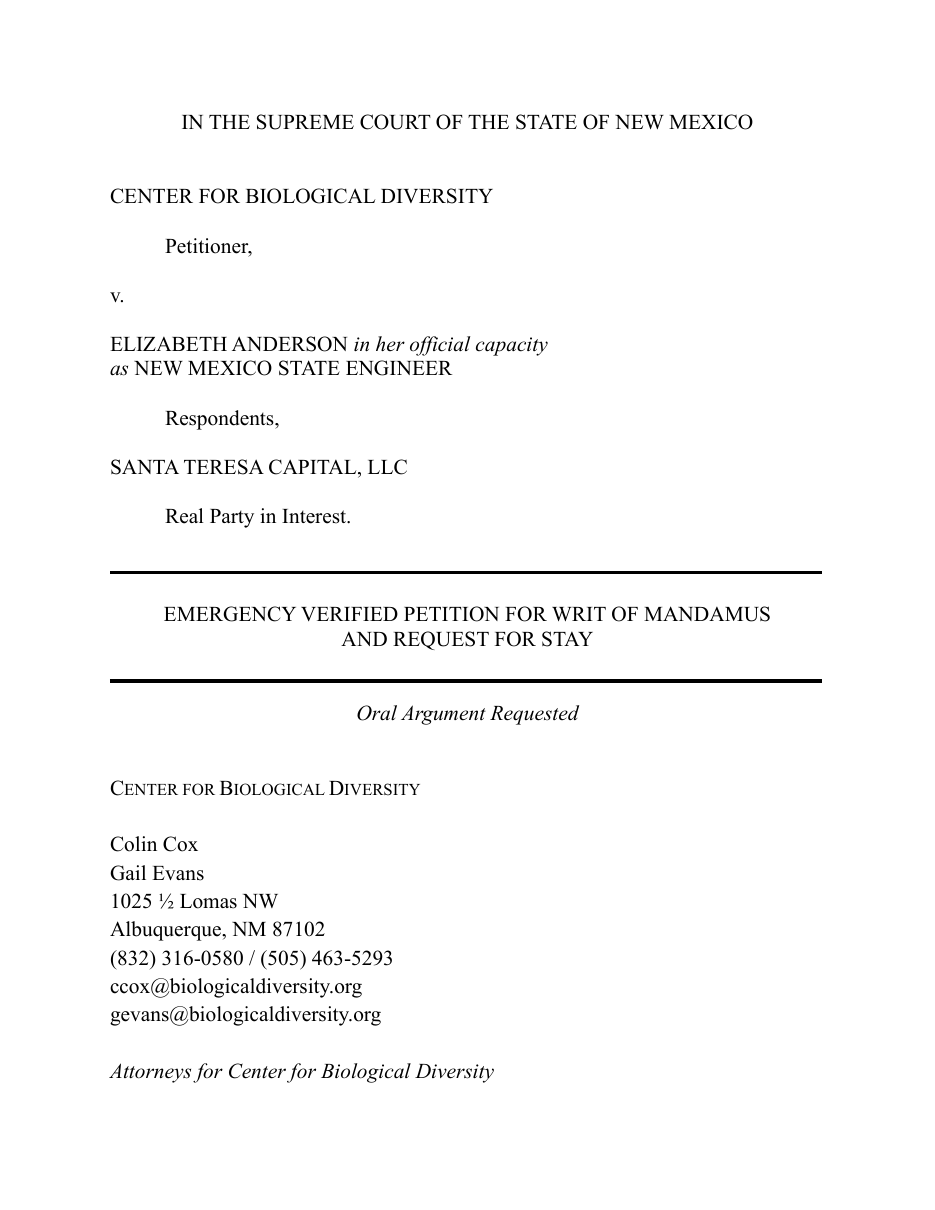
On September 2, 2026 the New Mexico Department of Justice filed in support of the Center’s petition — Center for Biological Diversity v. Anderson, No. S-1-SC-41580. The state’s chief legal officer, arguing against the state’s own water agency. Raúl Torrez: “The same rules must apply to everyone. Whether you’re a family defending a water right or a global corporation with money and political clout.”
The sharpest part of that filing is not about the statute. It is about the agency’s own standard. The Office of the State Engineer publishes guidance for its own staff — “Guidance re. Affidavits for Emergency Authorizations,” dated June 12, 2023 — telling them to look for “specific facts that support the existence of an emergency” and for “[s]ome unexpected event.” Where an applicant claims economic loss, it tells them to ask whether the application gave a “specific description of the loss . . . [i]ncluding, but not limited to, contract damages, or penalties as a result of the delay caused by publication.” The Attorney General’s position is that Santa Teresa Capital gave no such description, so the finding of serious economic loss was unlawful for want of a showing — and that what was asserted was a loss of economic opportunity, not a loss of investment. He attaches the guidance as an exhibit, and cites two of the State Engineer’s own hearing officers rejecting comparable claims.
This page has said for months that “crop loss or other serious economic loss” is in the statute, and that the October 2025 finding was therefore not invented. That remains true and the page is not withdrawing it. The Attorney General’s version is narrower and better: the question was never whether the words are in the statute, but whether anyone made the showing the agency’s own guidance requires.
And the State Engineer’s answer, which is not about volume
The case against her office is on this page at length, so her answer belongs on it too. On August 24, 2026 Rep. Melanie Stansbury wrote to five state officials asking for a “clear public accounting” of the project’s water by August 28. State Engineer Elizabeth Anderson answered on the deadline.
The construction water, she wrote, was purchased from the owner of an existing water right already permitted for “irrigation, municipal, industrial, commercial, and recreational purposes” — 2,400 acre-feet a year from wells covering 32,000 acres, in consistent use for twenty years at annual production between 130 and 2,500 acre-feet. Since November the holder has diverted 1,445 acre-feet, which she states is “within the authorized Water Right use limit … and includes water uses for the Project Jupiter construction site.” On the compact question: because the use is verified and pre-existing, “it is not a new depletion of water in the Lower Rio Grande.”
That is a real answer and it is not answered by repeating the volume. If the right already permitted industrial use, then the dispute narrows to one question: whether moving that use to a new place and a new purpose required notice and a hearing first. Which is the question now before the Supreme Court — and the one her office has not yet had to argue.
Two of her office’s numbers will be quoted against each other, so this page will say what each measures. 1,445 acre-feet is everything diverted under the whole right since November, across wells covering 32,000 acres, of which the campus’s construction is one use among several. 318.001 acre-feet — 103,620,944 gallons — is the totalizing meter on the new well alone, between April 14 and July 31. Neither contradicts the other; the larger covers more wells and more time. What the pair shows is that the agency can measure this water precisely when it is asked to, which is the fact the ten-month absence of a hearing sits most awkwardly against.
The congresswoman’s letter also put the year on the record, and it is the context every figure on this page sits inside: record-low snowpack and statewide curtailments, Elephant Butte Reservoir at its lowest storage since 1971, and the Rio Grande run dry through the middle reach for more than three months — one of the longest such stretches recorded.
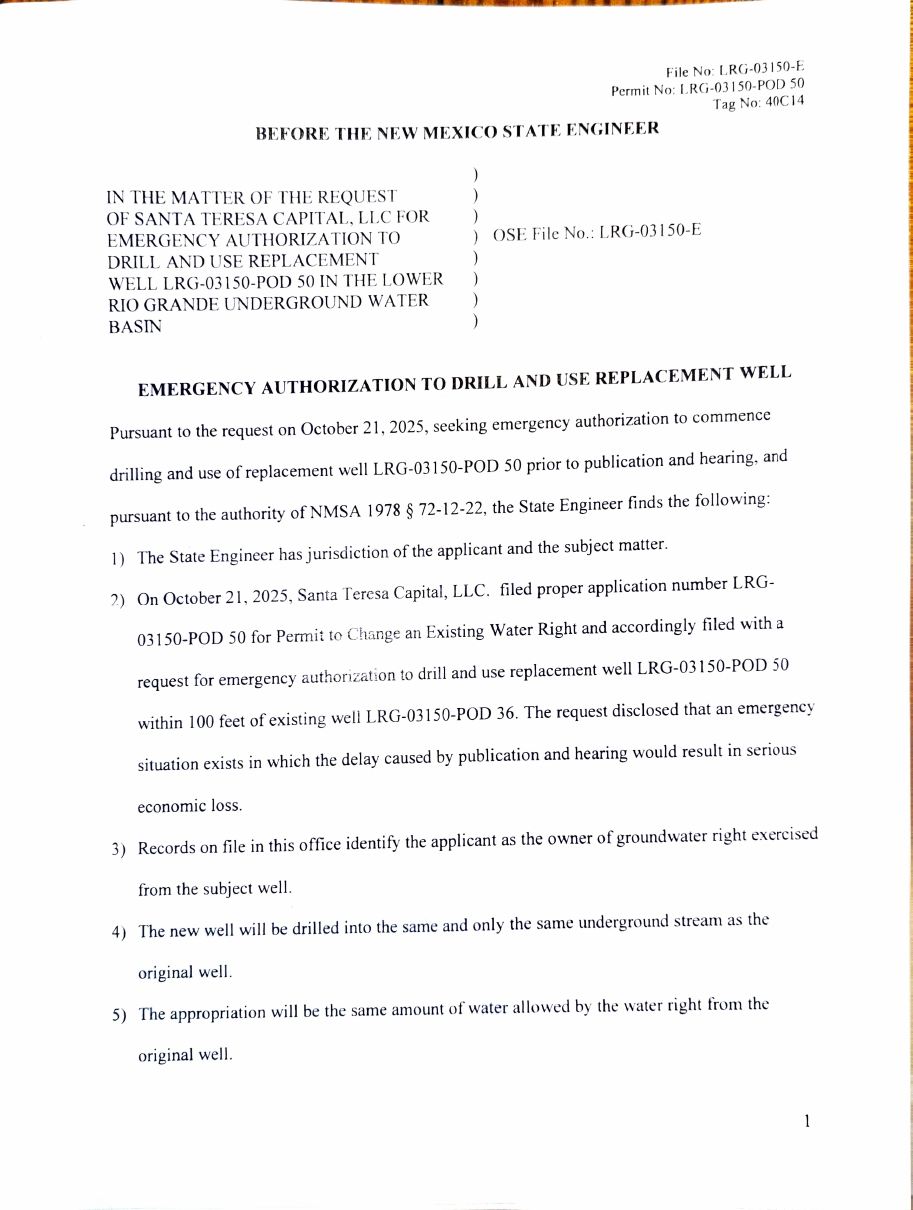
The petition carries the authorization itself as an exhibit, so the record now has the document rather than a description of it. Emergency Authorization, File LRG-03150-E, Permit LRG-03150-POD 50, tag 40C14 — signed for the State Engineer’s District IV office by Deputy District Manager JR Hennessey on October 23, 2025, two days after the request. The new well sits within a hundred feet of the old one. Its conditions are narrow: the same underground source, the same amount of water, the same place and purpose of use as the right it replaces.
And the statute is narrower than a headline suggests. § 72-12-22 lets a replacement well be drilled ahead of publication and hearing only where the delay “would result in crop loss or other serious economic loss.” The order finds economic loss. Economic loss is in the statute — this record will not pretend the finding was invented. The Center’s argument is a different one, and it is worth stating precisely: that this was not a replacement at all but a new use, which §§ 72-12-3 and 72-12-7 require the State Engineer to advertise and hear before granting. That question is now before the Supreme Court, which has decided none of it.
What is documented, and not in dispute, is the calendar. Protests were due January 9, 2026, and the Center filed one. On April 16 the State Engineer’s office acknowledged it, enclosed the protests, and wrote that it would file a Request to Docket the protested application. As of the Center’s August 20 petition — seven months after the deadline — no hearing had been docketed. The meter ran the whole time.
What is NOT shown here: the Supreme Court’s two orders of August 23. Orders in a pending mandamus proceeding are not published as PDFs, and the state’s Case Lookup sits behind a bot check this record will not work around. The orders are reported by Organ Mountain News and their existence is not in doubt; until the documents themselves are in hand, they are cited as reporting and not as primary source. On September 17 the Court denied the petition and lifted the water stay without explanation; the authorization is active again, and the protests — thirty or thirty-two of them — still await the hearing the State Engineer told Congress her office was working to schedule. Those September orders are likewise not shown here.
And the timing collides with a court order. On May 26, 2026, the Supreme Court’s final decree in Texas v. New Mexico ordered the state to retire 18,200 acre-feet per year of groundwater pumping in this very basin. The State Engineer’s calculation for Jupiter — about 1,120 acre-feet a year of new industrial demand — arrives inside the zone New Mexico is legally required to relieve. Whether it counts against the decree is now one of the record’s open questions.
03The fuel-cell pivot — gains and ceiling
The April 2026 switch from gas turbines to Bloom fuel cells is a genuine improvement: roughly 92% less NOx, and no cooling water for power generation. The record should say so plainly. It should also say what didn’t change: the cells still run on natural gas — 271 million cubic feet of it a day at the filed capacity of 2.45 gigawatts. At that scale the manufacturer’s own CO₂ specification works out to roughly 6.6–8.1 million tons per year — even accepting Oracle’s framing of a 21% cut versus the turbine plan, a carbon footprint the size of a city, delivered by a pipeline with a permit fight of its own.
Those are percentages. The absolute tonnages — 37.2 tons of NOx, 75.4 of fine particulates, 161 of carbon monoxide a year — and the basin they land in are on the Air page, along with the thirty-year nonattainment record and the monitors. Air — the airshed and the permit →
Worth noting: Oracle’s September 2025 congressional fact sheet still described “Siemens and GE gas turbines” — the campus’s power technology changed twice between the county vote and the current permit application.
04What cooling architecture decides
Water use is set by engineering choices, not company virtue. The same company, two designs:
Jupiter’s closed-loop design sits at the efficient end of that spread — if the filings match the claims. That is a real engineering achievement and a real open question, in the same sentence.
05The desert underneath
The campus sits in the Chihuahuan Desert over the Mesilla Basin — an aquifer shared by New Mexico, Texas, and Mexico, governed by the Rio Grande Compact and active Supreme Court litigation. Meta’s data center just across the state line holds a 750,000-gallon-per-day permit on the same water table that fills the taps of Chaparral, Sunland Park, and El Paso. Federal researchers already count one-fifth of data-center water as coming from stressed watersheds; this corridor is among the most stressed in the country. No single regulator sees the whole aquifer.
That litigation is now over, and it ended in an obligation. On May 26, 2026, the U.S. Supreme Court entered the final decree in Texas v. New Mexico — one paragraph closing a thirteen-year case — and under it New Mexico must achieve 18,200 acre-feet a year of depletion reduction in the Lower Rio Grande within ten years, at least half of that within five. The state’s chosen instrument is money: a $150 million program to buy groundwater rights from willing sellers and retire them permanently, plus payments to farmers who fallow their fields. New Mexico is spending public funds to take water out of use in this basin.
The campus draws from the same basin, on a right the state could otherwise have bought. And the decree does not resolve that: it is sector-neutral — a net reduction target with no formula separating farms from factories — and it imposes no moratorium on new appropriations. New Mexico’s own negotiator put it plainly to the Texas Tribune: the settlement “doesn’t dictate what sector the water savings comes from.” Which leaves the question nobody has answered on the record. No document in the Supreme Court’s file, the Special Master’s report, or the State Engineer’s program materials addresses how a new large industrial groundwater user in the Lower Rio Grande squares with an obligation to reduce depletions there. That question is deferred to a state water-management plan due by May 2028 — after the permit is decided.
06What nobody is required to tell you
- Operator water metrics exclude the water consumed generating their electricity — 211 billion gallons a year in the US, invisible in every corporate disclosure.
- Construction water is not tracked by the county agreement at all.
- There is no federal or New Mexico law requiring data centers to disclose water use.
- The water-balance sheets filed with the air-permit applications are the only documents that can settle the 20,000-versus-1,000,000 dispute. They were still not public when the decision was pushed to a hearing — and the county has withheld related records under a terrorism exemption.
07The fuel chain
Project Jupiter’s Bloom fuel cells use no water to make power. That part is true. The natural gas they burn tells the other half of the story — and it starts with the utility next door.
El Paso Electric keeps the lights on for about 407,000 households across the valley. In 2024 it generated 5.79 terawatt-hours of electricity from natural gas — and gas is 81% of everything it owns: 2,168 of its 2,844 megawatts of owned capacity. Jupiter’s filed 2.45 gigawatts is a single private campus with a generating fleet roughly 13% larger than the entire gas fleet of the utility that serves the whole region.
That fuel supply has failed once already, at scale. In February 2021, Winter Storm Uri froze wellheads and gathering lines across the Permian Basin and Texas gas production fell by nearly half. Gas-fired units accounted for 58% of every generator that tripped offline, and 87% of the fuel-related failures were natural gas. More than 4.5 million Texans lost power — some for four days — and at least 246 people died.
El Paso did not go dark. It sits on the Western Interconnection — not the isolated ERCOT grid that serves most of Texas — and it had weatherized its equipment after an earlier freeze in 2011. Its resilience came from what it was not wired to. Project Jupiter’s design runs the risk the other way: a microgrid marketed as “independent” would depend entirely on uninterrupted Permian gas — 271 million cubic feet a day for the East Microgrid alone — carried by a single 24-inch, 17.7-mile lateral, the Green Chile Pipeline, that has no permit yet and is fed by the same wellhead-and-gathering infrastructure that froze in 2021.
And the gas carries a water cost of its own that appears in no operator disclosure. Federal USGS accounting puts hydraulic-fracturing water use in the Permian at roughly 4 to 5.5 million gallons of fresh water per well — up from about 0.6 million a decade earlier. Extraction then brings water back up: the basin produced more than 20 million barrels of “produced water” a day in 2024 — about three barrels of waste brine for every barrel of oil — in a region where more than 70% of wells already sit in extreme water stress.
The 211-billion-gallon figure above counts the cooling water at power plants. It does not count this. The full water footprint of a gas-fired campus begins hundreds of miles upstream, at the wellhead.
08The national picture — and why it doesn’t answer the local question
Nationally, the numbers cut against alarm — and this page won’t pretend otherwise. U.S. data centers used about 228 billion gallons of water in 2023, most of it embedded in the electricity they buy rather than the cooling they run — and agriculture, lawns, and household plumbing each dwarf that. A single hamburger really does out-drink thousands of AI prompts. If the question is “is AI drying out America,” the honest answer is: not close.
But water is not a national resource. It is a basin resource, and no aquifer is refilled by another state’s rain. The same CBS analysis that supplies the comfort also names New Mexico among the water-stressed states where data centers are concentrating — while the research on where new ones should go points to Texas, Nebraska, South Dakota, Louisiana, Idaho. Not here.
The economist in that same piece says the quiet part: “the straw that breaks the camel’s back is only gonna break the back because all the other straw is on the back first.” In a basin already carrying agriculture, three states, two countries, and a Supreme Court case, the marginal million gallons a day is the straw. The question was never whether AI is thirsty nationally. It is who decided this basin could afford a heavy drinker — and on what numbers: a potable-only cap of 20,000 gallons a day, with the qualifier added after the vote, or the State Engineer’s working estimate of a million a day for everything.
This page holds both truths at once: the engineering here is close to the best the industry has, and the disclosure around it is close to the worst. Honest accounting requires saying both.