The Watch · Air
Air
The decision this whole site counts down to is an air permit. It is being decided over a basin that has failed the federal ozone standard since 1995 — and that, after thirty years, is now one part per billion from passing it. What gets added at exactly this moment is the question.
01The bowl
The Paso del Norte airshed is a bowl. The Franklin Mountains wall it on the east, the Sierra de Juárez on the southwest, Mount Cristo Rey stands between them, and inside sit El Paso, Sunland Park, and Ciudad Juárez — roughly 2.7 million people sharing one body of air. Terrain traps it. The agencies use the word themselves.
Three jurisdictions, two countries, one air mass. Emissions cross those lines in both directions all day, and the monitors record whatever arrives — they cannot tell you whose it was. Everything that follows on this page is a consequence of that single physical fact colliding with a set of legal instruments that were each drawn around a jurisdiction.
02Thirty years of failing — and nearly done recovering
Nonattainment is not a warning. It is the federal government’s formal finding that the air people breathe in a place fails a health-based standard. Part of Doña Ana County has carried that finding since July 1995, when the original “Sunland Park area” designation named Sunland Park, Santa Teresa, and La Union. The current designation — Marginal under the 2015 ozone standard of 70 parts per billion — took effect in August 2018. The area missed its August 2021 attainment deadline with a design value of 78 ppb.
Then it got better. This is the part of the story that rarely gets told, and it belongs here first: across the last four official measuring periods, the basin has very nearly recovered.
| Monitor | 2018–20 | 2021–23 | 2022–24 | 2023–25 |
|---|---|---|---|---|
| Desert View / Sunland Park35-013-0021 | 78 | 79 | 72 | 68 |
| La Union35-013-0008 | 70 | 76 | 76 | 71 |
| Chaparral35-013-0020 | 72 | 70 | 70 | 65 |
| Santa Teresa35-013-0022 | 74 | 72 | 70 (invalid) | 70 (invalid) |
| Solano35-013-0023 | 70 | 67 | 69 | — |
Ozone design values, parts per billion. The standard is 70. Source: EPA design-value workbooks.
Two things fall out of that table. The first is that the recovery is real and recent: Desert View, the basin’s worst monitor, dropped from 78 to 68 — below the standard. Every monitor in the area now reads clean except one. La Union, at 71 ppb, holds the entire area in violation by a single part per billion.
The second is quieter and it is the finding. The monitor closest to the proposed facility — Santa Teresa, about 3.3 miles away — has produced INVALID data for the last two consecutive measuring periods. It failed completeness. The nearest working monitor is Desert View, roughly nine miles east, and no monitor of any kind sits at the facility site. At the moment a 2,462-megawatt source is being permitted, the instrument nearest to it is the one not producing usable numbers.
To be precise about what the permit does and does not require: it requires a great deal of monitoring AT THE SOURCE. NMED’s draft directs the applicant to expand its monitoring plan beyond temperature and pressure to continuous tracking of startup and shutdown events, gas flow rate, electrical output in megawatts, exit sulfur concentration, and natural-gas leak rates at the fuel-cell units. That is a real instrument package, and it answers a real question: what is coming out of this facility.
It is a different question from what is in the air over Sunland Park. Source monitoring measures the plant. Ambient monitoring measures the bowl. No ambient monitoring requirement appears in the draft permit, which is ordinary for a construction permit and is not a lapse by the department — it is simply not the instrument this proceeding uses. The gap is structural, not anyone’s oversight.
Doña Ana is a two-nonattainment-area county: Anthony, New Mexico carries a separate PM-10 designation, classified Moderate, designated in 1991 and never redesignated — no maintenance plan was ever developed, and the area still exceeds. The missing-meter pattern appears elsewhere in this record →
03Every instrument measures something other than the bowl
Two mechanisms decide how the basin’s failure is accounted for, and neither of them asks about the basin.
The first is the international excuse. Under Clean Air Act §179B, the region argued it would have met the standard but for emissions from Ciudad Juárez. The inventory behind the argument is substantial: Juárez contributes an estimated 64% of regional nitrogen oxides and 67% of volatile organic compounds, and back-trajectory modeling puts Mexican-airspace influence on 80% of exceedance days at Desert View. EPA proposed to approve it in March 2023, which would relieve the area of mandatory reclassification to a stricter Moderate regime. That proposal was never finalized. It has sat pending for more than three years — while comparable §179B determinations elsewhere, including Phoenix-Mesa, were finalized in 2026. The area is neither formally excused nor bumped up. It waits.
The second is the line itself. A new source inside the nonattainment boundary faces a 100-ton-per-year major-source threshold and must buy offsets at 1.1 to 1. A new source outside it faces 250 tons and no offsets. Per NMED’s own modeling report, this facility sits about six miles west of the boundary.
| The instrument | What it asks |
|---|---|
| The nonattainment boundary | Where is the source — inside the line, or outside it? |
| The §179B determination | Whose emissions caused the exceedance — ours, or another country's? |
| The permit threshold | How much does this one source emit, measured against 250 tons a year? |
| The permit itself | Does this facility, modeled alone, cause an exceedance at its own fence line? |
| How much can the basin hold, and how much is already in it? | — no instrument asks — |
Nothing here is a malfunction. Each instrument is doing exactly the job it was designed to do. The consequence is simply that existing exceedances are attributed across a border and new emissions are sited across a line — and the basin’s total load is nobody’s question. The monitors record the sum either way. The instruments only decide who has to answer for it.
“The air doesn’t stay over one area, it is all of ours. It’s part of the commons.”— Sen. Bill Soules, legislative listening session, August 11, 2026 · quote pending audio verification
The boundary is administrative. The airshed is physical. A molecule of nitrogen oxide emitted six miles west of a line makes ozone in the same bowl it would have made six miles east of it.
New Mexico already knows how to govern a shared scarce thing. The people of this valley were irrigating from communal ditches long before the Spanish arrived; the engineering and the very word came by way of the Moors — acequia, from the Arabic al-sāqiya, the water carrier — and the Spanish named and codified what they found and brought. What resulted is an institution whose whole job is the ditch itself: shared, mapped, with a mayordomo answerable to everyone on it. The airshed over Sunland Park has no equivalent. There is no institution whose job is the bowl.
04The permit, honestly
Four things must be said before anything else, because they are true and because a record that buries them cannot be trusted with the rest. The facility is outside the nonattainment boundary — that is NMED’s own finding, not the applicant’s claim. The fuel-cell redesign is a genuine reduction in criteria pollutants: from caps of 249.97 and 248.90 tons of NOx a year across the two withdrawn applications to 37.2 in the current one, about thirteen times lower. The current application requests Title V major-source status outright — it asks for the heavier oversight regime rather than ducking it. And the largest criteria figure in the application is one the vendor itself disputes: the application records that the manufacturer “maintains that there are zero PM emissions from its equipment” and that testing “may exhibit positive sampling method bias” — and the applicant adopted the conservative particulate factor over its own supplier’s position. That is a genuine point in their favor, and this page says so plainly.
The two withdrawn applications requested caps of 249.97 and 248.90 tons — three-hundredths and one and a tenth of a ton under the 250-ton line at which federal review attaches. Their own tables put the East facility’s uncontrolled potential at 3,699.16 tons: the caps were built not from hardware but from dispatch promises — “only thirty (30) units will operate at 100% load”; “not more than five (5) turbines will operate simultaneously.” A cap that is a promise about how many turbines run is not a control technology. Both applications were withdrawn in April 2026, the day the department decided to hold a hearing. That story is told in full in the Friction Ledger →
| Pollutant | lb/hr | tons/year | Note |
|---|---|---|---|
| NOx | 8.494 | 37.2 | Minor source for PSD |
| CO | 36.815 | 161.21 | The application’s own figure — NMELC’s independent number matched it |
| VOC | 28.313 | 124.01 | Above the 100-ton nonattainment major-source line — see below |
| PM10 / PM2.5 | 17.214 | 75.4 | Larger than the NOx figure everyone argues about |
| SO2 | 0.02 | 0.09 | — |
| Hazardous air pollutants | 0.32 | 1.42 | Methanol 1.15, benzene 0.20, xylenes 0.07 — well below the 10/25-ton thresholds |
From the application’s own summary tables — NMED Universal Air Quality Application, prepared by Trinity Consultants, 648 pages, cover letter April 27, 2026: Bloom Energy Server 6.5 units, 2,462.005 MW, 8,760 hours a year, 15% safety factor included. Cross-checked against NMED’s June 16 modeling review, which carries the same hourly rates.
An earlier version of this page said the two most-circulated figures — ten million tons of greenhouse gas and 124.01 tons of VOC a year — belonged to the withdrawn East and West applications and should not be attached to this permit. That was wrong. Both figures are in the current application’s own summary tables, and the opponents who cited them were quoting the live document accurately. The full application has now been read, and this page is rebuilt from it.
The application’s own greenhouse-gas figure, Table 2-P: 10,144,115 tons of CO2-equivalent a year. Methane and nitrous oxide are entered as zero, so the figure is essentially all carbon dioxide — from natural gas, running around the clock. The estimates this site previously carried in its place are retired.
And one number in that table crosses a line the argument has been looking past. 124.01 tons a year of VOC exceeds the 100-ton threshold at which a source inside a nonattainment area is major for Nonattainment New Source Review. The facility sits about six miles outside the boundary, so that review does not apply — but inside the line, this would be a major source for VOC, an ozone precursor, facing emissions offsets and Lowest Achievable Emission Rate. The boundary question this page keeps returning to is live on VOC, not on NOx.
What survives all of that is simple arithmetic. Thirty-seven tons of NOx, one hundred twenty-four tons of VOC, seventy-five tons of fine particulates, and a hundred sixty-one tons of carbon monoxide a year are additions to a basin sitting one part per billion from compliance after a thirty-year climb — and above them, ten million tons of CO2-equivalent. They are small measured against a threshold. They are not zero measured against a bowl. The thresholds ask about the source; the bowl does not care about the source.
The particulate number deserves its own sentence. At 75.4 tons a year, PM2.5 is the largest criteria pollutant in this application — twice the NOx that dominates the argument — and it is the pollutant for which the health literature has never established a safe threshold.
05Who breathes it
Sunland Park, Santa Teresa, La Union, Anthony. Border communities, largely Hispanic, and the county’s colonias — roughly 37 of them, home to about 13,000 people. These are the places named in the 1995 designation and the places the monitors sit in.
Ozone is a respiratory irritant; it inflames airways and worsens asthma, and children are the sensitive population by consensus of the health agencies. This record does not and will not claim that this facility will cause a particular number of cases — that claim cannot be made honestly from the documents. What can be said is the burden that already exists. In 2021, 16.3% of Doña Ana County teenagers reported having been diagnosed with asthma. Statewide, about 30,000 New Mexico children have it.
Set that against the sequence this same population has lived through: a water utility that bypassed three of four arsenic treatment plants for over a year, found in 2023 and settled in 2026 with all plants now compliant; ozone nonattainment since 1995; a separate particulate nonattainment area at Anthony; discolored tap water reported as recently as August 2026; and now a 2,462-megawatt gas-fired campus. Each of those is documented and none of them is the same problem. They land on the same people.
The federal instrument that would have counted exactly that accumulation — environmental-justice review in data-center permitting — was removed by executive order in July 2025, one month before the county adopted its bond resolution.
The school district serving these communities, Gadsden, receives $820,456 a year from the project’s payment in lieu of taxes — about seventy dollars per student. The full arithmetic is in the record →
The withdrawn applications answered one open question on this page: they state the distance from the facility to the nearest residence, school, or occupied structure as 1,500 meters — a fact from the applicant’s own filing, not this record’s measurement. One thing this section still does not have and will not guess at: the county’s pediatric asthma hospitalization rate, which sits behind an interactive state query and has not been pulled.
06The clock, and the phase
That hearing is no longer scheduled. On August 23, 2026 the New Mexico Supreme Court stayed the entire administrative proceeding on this permit — unanimously, all five justices — while it considers New Energy Economy’s petition for a writ of mandamus. The September 14 hearing at the Sunland Park Multi-Generational Center, the August 24 technical-testimony deadline, and the September 3 rebuttal deadline are all suspended with it. The order decides nothing about the permit itself; it stops the clock while the Court looks at how the clock was set.
Four things have happened since. The applicant asked the Court to let the proceeding restart in pieces — enough to file prehearing submissions — warning that a continued stay risked making the November 23 decision deadline “impossible to meet.” On September 1 the Court denied it unanimously, without comment. The hearing officer recused himself on August 22, three days after two conservation groups moved to disqualify him. On September 2 the Attorney General of New Mexico filed in support of the petition, against the Environment Department. And on September 17 the Court denied the petition and lifted the stay — with no explanation, and without reaching any of the Attorney General’s arguments. A denial of mandamus is a decision not to intervene; it is not a finding that the process was lawful. The proceeding resumes with no hearing officer and no hearing date, sixty-seven days from a decision deadline the department has said nothing about.
And then nothing. NMED’s own public docket for this proceeding holds eighty filings; read on September 21, the most recent is dated August 24 — an entry of appearance. Four days after the Court lifted the stay, no replacement hearing officer has been named, no scheduling conference set, and no hearing date announced. The department said it would appoint a replacement once the stay lifted. The stay lifted. The decision deadline it set for itself is sixty-three days away.
Update, October 2: the chair is filled. Cabinet Secretary James Kenney appointed “The Honorable James O. Browning” as substitute hearing officer — a United States District Judge for New Mexico from 2003 until retirement on August 28, 2026. The notice keeps the delegation of “all final and dispositive decisions” with Deputy Cabinet Secretary John Rhoderick. It sets no scheduling conference and no hearing date. The notice (PDF) ↗ Federal Judicial Center biography ↗
Both of those orders are now on this page as documents, read from NMED’s own docket rather than from accounts of them. The recusal is one page: the hearing officer denied the parties’ motion for a hearing on his disqualification, and then disqualified himself, “effective immediately.” The Supreme Court’s stay is two: the proceeding “STAYED until further order of this Court,” five justices concurring, filed at 8:21 on a Sunday night. Its witness clause is dated the 23rd of October — the month is a typographical error in the Court’s own order, and this record notes it because it publishes what it reads.
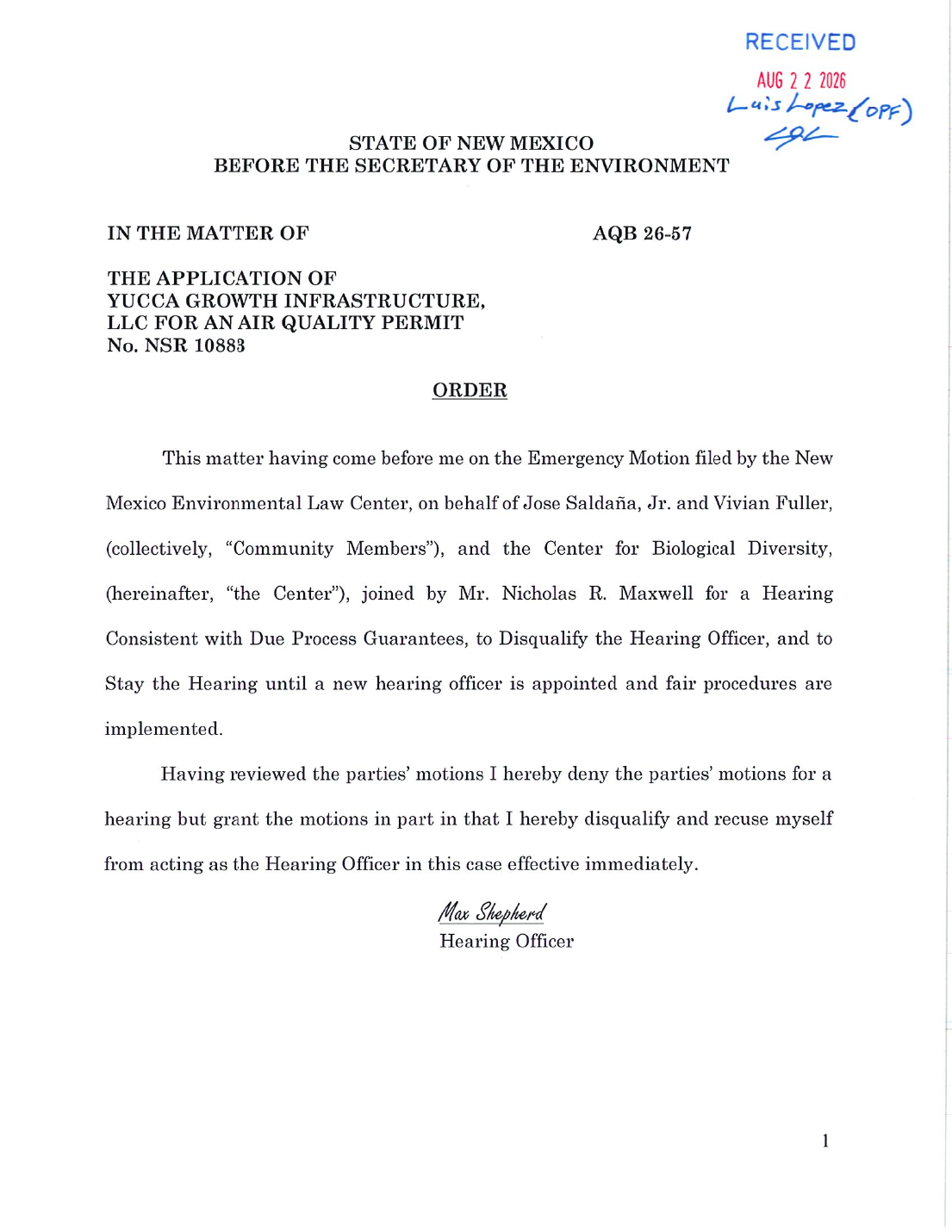
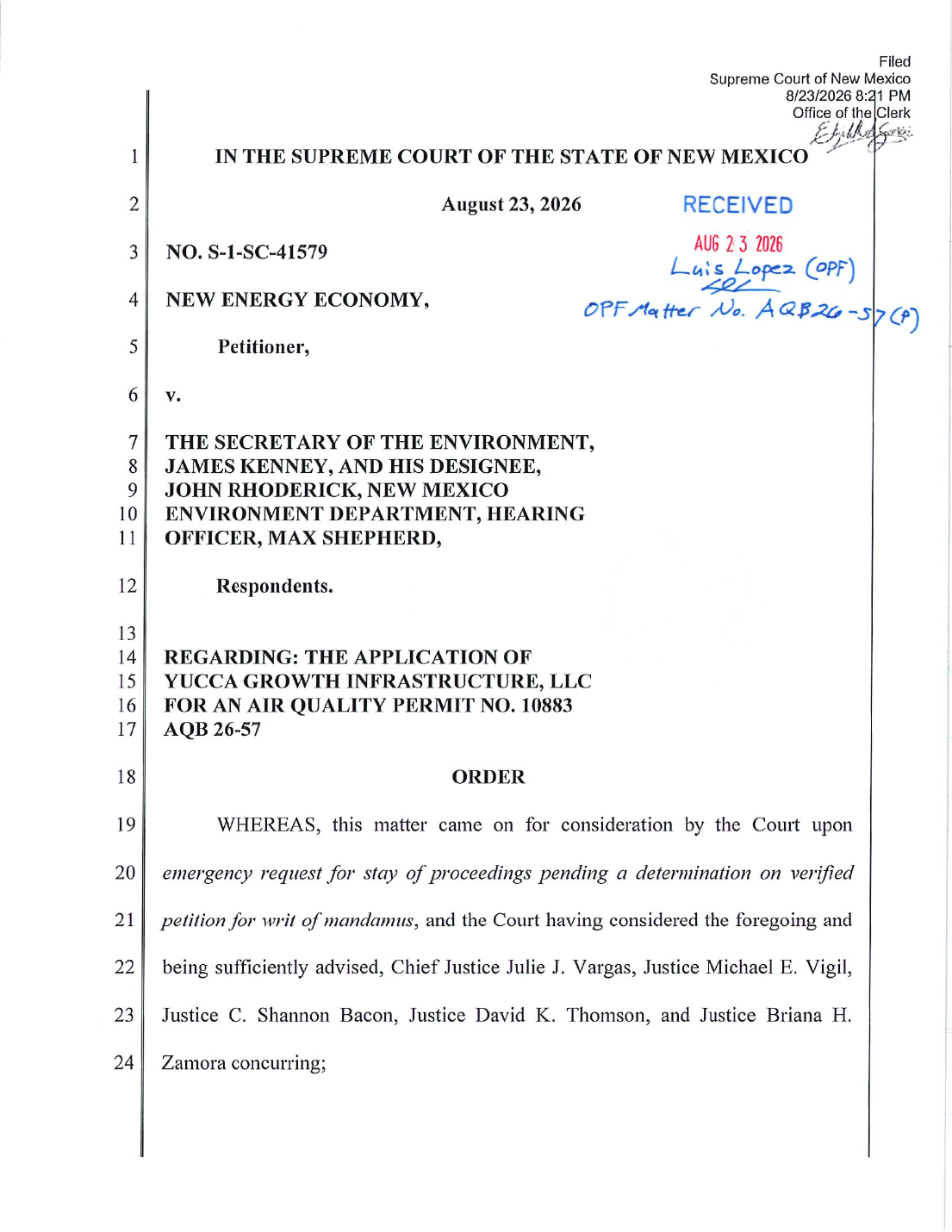
What the Attorney General filed, and what he did not say
New Energy Economy v. Kenney, No. S-1-SC-41579. The response opens without hedging: “The New Mexico Environment Department violated the constitutional due process rights of Petitioner.” On the plant it is equally direct — the 2,275 Bloom fuel cells are an unprecedented number, which “prohibit comparison to another facility already in operation as there are none—in the world.”
One argument in it deserves to be read slowly, because it dismantles the premise every acceleration in this proceeding was built on. Every compression was justified by the November 23 decision deadline. The Attorney General says the deadline was never a wall: NMSA 1978, § 74-2-7(B)(3) lets the department extend its own permitting deadline for good cause — including for a public hearing and for unusually complex technical issues, both of which this matter plainly has. If that reading holds, the reason given for every schedule change here was a choice presented as a constraint.
The Department’s own position is the opposite, and it has been in the docket since July. Its Position Statement of July 22, 2026 calls November 23 “the statutory permit decision deadline under NMSA 1978, Section 74-2-7(B)(2),” and affirmatively commits to meeting it. Two agencies of one state government, citing adjacent subsections of one statute to opposite effect — (B)(2) as the deadline that binds, (B)(3) as the power to move it. The Supreme Court denied the petition without reaching the question. What can be said is that the constraint invoked to compress a public process was contested inside the government that invoked it, and that the Department has said nothing about the deadline since the stay lifted.
The same filing carries a smaller thing worth keeping. The Department says it “was prepared to make all required postings and publications on July 17, 2026, and refrained from doing so upon receipt of the Hearing Officer’s July 16, 2026, Scheduling Order” — and a footnote concedes the notices went out on the 17th anyway, “the result of NMED’s inability to pull the publications on such short notice.” The department that would spend the next month being told there was no time was, that week, holding notices it had already prepared.
The filing also sets out a sequence, and this page will give the dates before it gives anyone’s reading of them. July 15, 2026: the hearing officer sets the hearing for October 19, citing complexity and due process. July 27: he rejects the applicant’s request to accelerate, finding the developer’s financial exposure arose from proceeding without a permit and did not outweigh due process. That same day, representatives of Oracle met with the Governor’s Office — a meeting the filing sources to the petition’s Exhibit C and to the Governor’s own published calendar. July 29: he reverses without explanation, moving the hearing to September 14 and pulling technical evidence forward by nearly forty days.
The Attorney General argues that a reversal “only two days following the Governor’s Office meeting with Project Jupiter representatives … lends itself to a conclusion that egregious and shocking actions have interfered with the substantive due process rights” of the petitioner. That is his argument in a brief, and this record will not improve on it. He does not allege the meeting caused the reversal; the operative word in the filing is “following.” No court has found anything. The calendar entry is documented, the sequence is documented, and the inference belongs to the Attorney General — contested by the agencies it accuses.
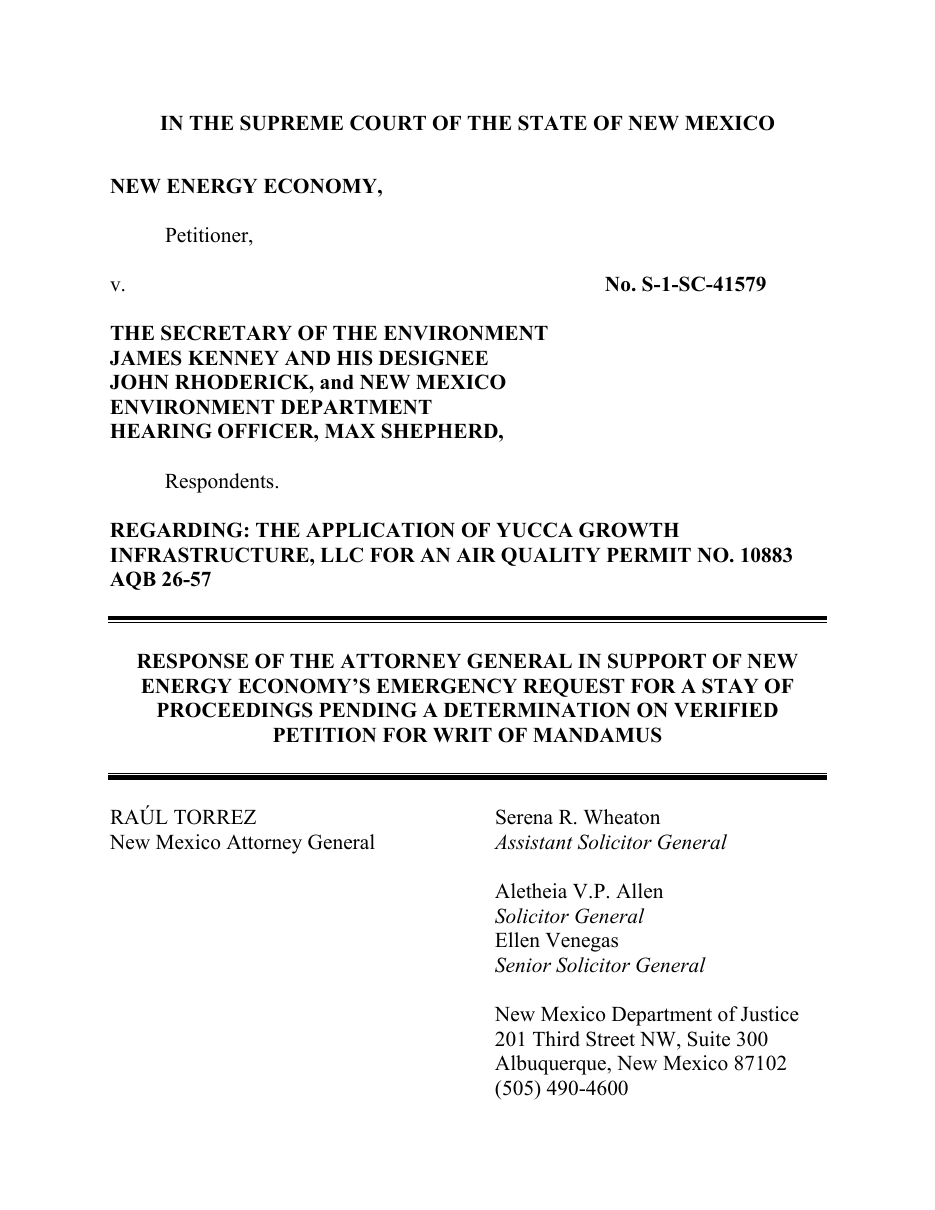
What was spent to shape this permit’s record — from the filing, not the coverage
On September 11, 2026 Oracle America, Inc. filed a Report of Advertising Campaign with the Secretary of State. Ten expenditures, every one to a single firm, Brabender Cox, between January 2 and April 6: media production, media buys, polling, general consulting. Total $3,444,500. Every line carries the same sentence — “Voluntarily disclosed in the interest of transparency. This disclosure does not constitute an acknowledgment the expenditure is required to be disclosed under the Lobbyist Regulation Act.” Ten disclaimers, sworn under penalty of law.
The State Ethics Commission’s release five days later says what the money did: a website with a fillable form that submitted supportive comments to NMED, broadcast and digital advertising directing people to it, paid influencers on TikTok and Instagram, and “a statewide canvassing operation in which paid canvassers carrying tablets solicited supportive public comments for submission to NMED.” Its comparison is stated more carefully than the headlines carried it: “the largest lobbying advertising campaign reported since 2021, the earliest year for which records are available.” With the applicant’s $3,667,000 through Elevate New Mexico — disclosed under a Commission settlement — more than seven million dollars has now been disclosed as spent to shape the comment record on this one permit. The Department of Justice is separately investigating how many of the comments in that record were filed in people’s names without their consent.
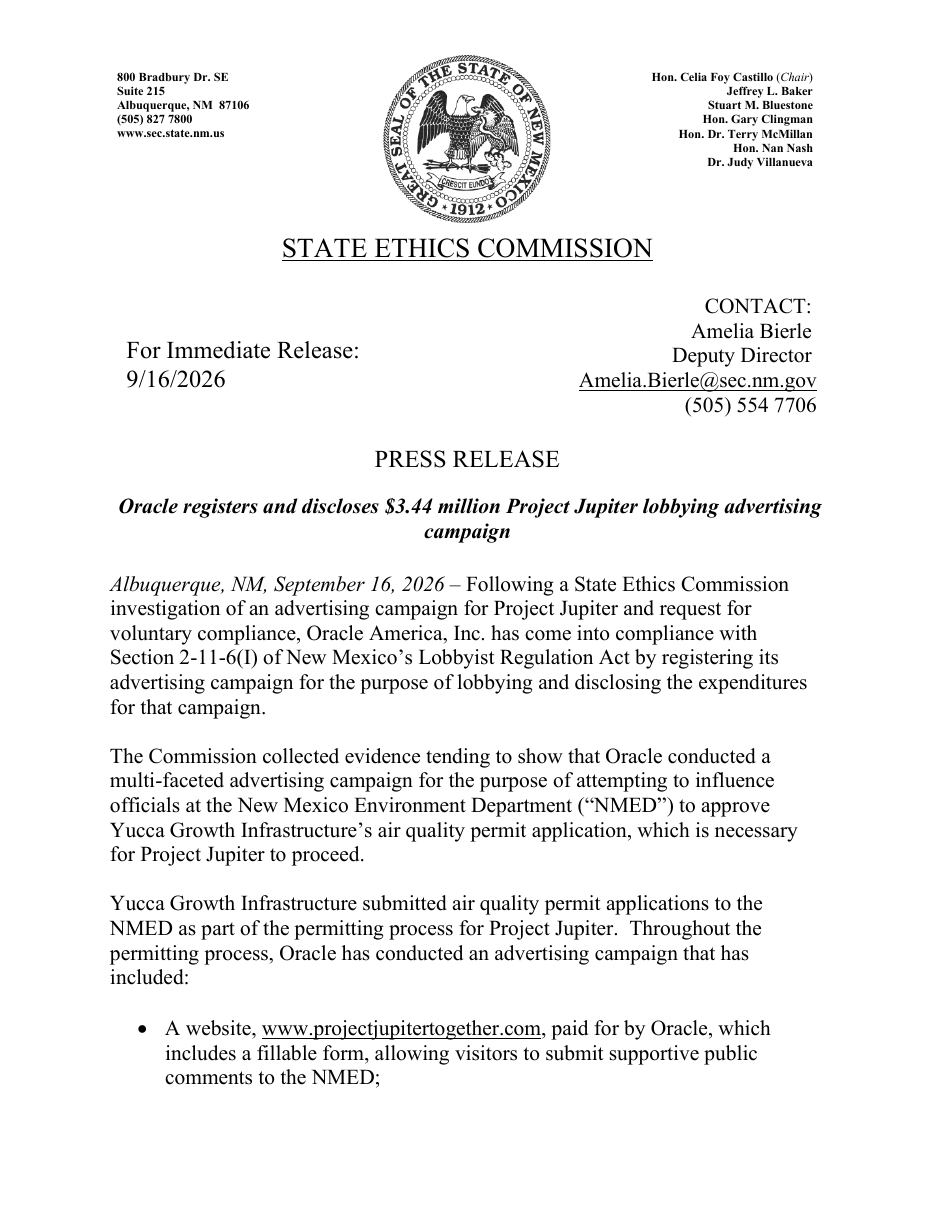
One detail from that caption is worth recording, with its limit stated first: nobody has alleged a connection between these two facts, no filing draws one, and this page does not either. The respondents are named as “the Secretary of the Environment James Kenney and his designee John Rhoderick.” The designee is the official designated to act for the Secretary on this permit. John Rhoderick, NMED’s Deputy Secretary of Administration, is also the official who appeared in a promotional video for Apaluma — a contractor on this project — endorsing the contractor’s product, a video taken down by May 2026. Both facts are documented, and they are recorded together because a reader building this record by hand would find them both and would want to know they are the same person.
Sixty times larger than anything the manufacturer has built
The proposed source is about 2,460 megawatts from roughly 2,275 Bloom Energy solid oxide fuel cells. From the filings: “By Applicants’ own representations, no comparable facility exists. The largest existing Bloom installation appears to be approximately 40 MW in Korea, making Project Jupiter roughly sixty times larger than Bloom’s largest demonstrated deployment.”
The Attorney General put the same fact without a denominator — the concentration is unprecedented and “prohibit[s] comparison to another facility already in operation as there are none—in the world.” The permit before the Department would authorize, at one site in Doña Ana County, sixty times the largest working example of the technology it rests on. The application’s own Responsible Official is a Bloom Energy vice president, who signed its certification at page 648 of 648.
There is a regulation for exactly this, and it is written in the mandatory. 20.2.72.208 NMAC is titled Basis for Denial of Permit: “The department shall deny any application for a permit or permit revision if considering emissions after controls” any of eight listed things is true. Subsection (G) is one of them — “it appears that the construction of the new source will not be completed within a reasonable time.” That is why the opponents argued their discovery was not collateral: if the technology has never been demonstrated at anything approaching this size, if the only identified pipeline has been denied the approvals it needs, and if there is no legally obtainable alternative fuel, then the Department cannot lawfully find that the regulation is satisfied. The hearing officer took it seriously enough on August 4 to order expedited briefing on whether any lawful gas source exists for the roughly 400 million cubic feet a day the project needs — then withdrew that order six days later as “inadvisably filed,” deferring it to hearing testimony. The hearing has not happened.
The applicant has an answer to that, and it is a serious one. Its August 7 brief argues that this is a MINOR source of air emissions — not listed on the table of major sources, and under the 250-ton-a-year threshold that would otherwise make it one — while subsection (G) “is most relevant to permits for major sources,” mirroring as it does the federal rules on construction by major stationary sources. It argues the clock is generous rather than tight: the minor-source rules give a permit holder two years to begin construction and another year of suspension before the permit is even eligible for cancellation, and only then after a hearing. “There is nothing in the statute or rules that suggests a project proponent must have every authorization needed for a project in hand to secure an air permit.” And it argues subject matter: even for major sources, the approvals that bear on timely completion are those required under air quality laws — not pipeline certificates, not state trust land crossings. Reading (G) the opponents’ way, it says, “would greatly expand the scope of a minor air permit hearing to issues unrelated to air quality.”
One clarification this record owes you: “minor source” there is a term of art from the prevention-of-significant-deterioration programme, and it does not contradict the Department’s own June modelling review, which found the site minor for PSD while stating it “will be a major source for Title V.” Different programmes, different thresholds, both true. Nothing in this argument has been ruled on. Discovery was denied five days later on separate grounds, and the hearing that would have decided it has not happened.
Then, on September 24, the tenant weighed in — not in the hearing, in its contracts. Bloomberg reported that Oracle had sent the developer a force majeure notice, which El Paso Matters reports would let it defer rent for up to three years if the campus’s power is not running on schedule. The two delays it points to are this air permit and the Green Chile pipeline. The date it protects is in the county agreement: the first 400 acres, microgrid included, complete by the third quarter of 2028. Oracle says such notices are “commonplace” and “do not, by themselves, establish a project delay.” Its own $4.7 billion benefit figure, as presented to county commissioners on July 28, carried a footnote: “These projections assume the air permit and pipeline are timely approved, as originally planned.”
That is an overlap of facts, and this page states it as one. The question the opponents wanted examined under subsection (G) — whether the source can be built in the time the application says — is the question the project’s own tenant has now treated as a contractual risk. It does not settle the applicant’s argument. Whether a delay threatens a lease and whether it is a ground to deny an air permit are different legal questions, and the second one is still waiting for a hearing.
The opponents also asked, in writing, how much scandium the fuel cells require and whether any of it is mined or processed in China — the rare earth at the core of each cell. They asked alongside an investigative article claiming Bloom’s public assurances about its China exposure do not hold. The Department urged the hearing officer to treat that article sceptically as investor-affiliated and not peer reviewed, which is a fair objection to it. None of it was resolved: discovery was denied in its entirety on August 12, the applicant never answered, and the proceeding was stayed eleven days later.
Who supplied the person deciding
The limits first, because the filing that established this stated them first. Nobody has found bias. Nobody has found an improper arrangement. The intervenor who assembled the documents wrote that they “establish a sequence of events and relationships while leaving material facts concerning the operation of that relationship unanswered,” and asked for disclosure rather than a finding. This page asks for nothing more than that.
Eastern Research Group has worked for the Environment Department since at least 2021. Its senior economist testified for the Department in a 2021 rulemaking. In 2023 the Department presented an ERG vice president as a consultant to its own Climate Change Bureau and entered the “ERG Report” among its exhibits. In 2022 ERG opened a Santa Fe office, describing it publicly as a way to build on several years of NMED work. Its master contract — worth up to $9,500,000 — authorizes technical analysis, permit review, air-dispersion modeling, and written and oral expert testimony for the Department.
On September 12, 2025 the Department amended that same contract to add a hearing-officer category: “ERG shall supply qualified personnel, hereafter referred to as ‘Hearing Officers,’ who are independent and neutral” — to preside over NMED proceedings, rule on evidence and objections, manage expert testimony, and write recommended decisions. The amendment was signed by Deputy Secretary John Rhoderick, on the line printed for the Cabinet Secretary. Nine months later the same Deputy Secretary was delegated final decision authority over this permit.
And in July 2026, after his appointment, the hearing officer wrote to the Department and to ERG: “I am currently waiting for Susan Day at ERG to complete my new service contract. Until that contract is in place I cannot perform any hearing officer duties.” Two days later the Department’s counsel followed up on the contract’s status, copying ERG, before the scheduling conference could be set. The governmental appointment and the contractual engagement were two separate events, and the proceeding waited on the second.
What the record does not show is who controlled the space between them — who identified him, who may decline to continue him, who decides whether he is assigned again. One part of the agreement authorizes the contractor to supply the Department with evidence; another authorizes it to supply the person who weighs that evidence. The agreement says those people shall be independent and neutral. It does not say by what mechanism. That question reaches every contested air-permit hearing the Department runs, not only this one.
This has been asked before, and no court has answered it
Whether an Environment Department hearing officer’s contract with the Department can require his disqualification is not a new question in New Mexico. It was put to the Court of Appeals in the appeal from the WIPP permit proceeding, where two conservation groups argued the hearing officer should have been disqualified “because of his contract with NMED” — an hourly arrangement they said gave him “an incentive to handle hearings to NMED’s satisfaction,” and whose absence of disqualification they called a “fatal flaw.”
The Court did not say they were wrong. It said it would not decide. “Appellants failed to preserve this issue by raising it below, raising it only after NMED issued its order, and we decline to reach it.” A footnote explains how the failure happened: they never introduced the contract during the hearing, and attached it instead to their brief on appeal. So the state has no ruling either way, and the reason it has none is procedural.
Two limits on what that means here. The opinion names no hearing officer — it says “the Hearing Officer” throughout — and the identification of him as the same person is drawn from a filing in this docket, not from the court. And the earlier argument was narrower: an hourly contract directly between the officer and the Department, with no contractor in between. Whether the arrangement in this proceeding is stronger or merely different is the thing nobody has ruled on. What the preservation holding does explain is why the contract documents were filed into this record before the hearing rather than after.
The standard, stated against ourselves
This page has logged a run of reversals and the motion that strung them together, so the test that argument would have had to meet belongs here too. Under New Mexico Supreme Court authority, adverse rulings are not a valid basis for disqualification for personal bias — not one of them, and not a series. The inquiry that applies is objective: whether the circumstances present a possible temptation to an average person sitting as a judge to decide with bias for or against a party. The intervenor who filed the contract documents said so himself, and distinguished procedural error from proof of subjective bias. He was equally careful about what he did not allege: no financial stake for the contractor in whether the permit issues, and no attribution of the contractor’s ordinary commercial interest to the officer personally. The question he put was structural — whether a contractor’s broader financial relationship with the Department can affect how an individual adjudicator is selected, engaged, compensated, retained or given future work.
The day after that filing, the hearing officer recused himself, giving no reason.
Minutes later the Court stayed something else: the October 23, 2025 emergency authorization that let water from the new well be used for construction. Different case, different agency, same night — and together they are the first orders in this entire record that stopped anything rather than letting it run while the argument continued.
The regulatory regime this permit is judged under is unresolved in both directions. Because §179B was never finalized, the area is neither excused from reclassification nor bumped to the stricter Moderate rules — while its design values improve toward attainment from the other side. Today’s siting happens against a regime that could tighten or dissolve, and either resolution arrives after the permit is decided.
What Texas did, and what it exempted
On August 3, 2026 the Governor of Texas ordered the state’s utility commission and grid operator to audit every data center advancing through ERCOT’s interconnection process, and halted those projects until the audit is done. About 474 gigawatts of connection requests were pending, roughly 90% of it data centers — more than five times the state’s record peak demand. It is the most aggressive state action against data-center siting in the country.
Read what it attaches to. The pause applies to projects asking to draw from the grid, and only to large ones — 75 megawatts and above. Facilities that build their own power and never enter the interconnection queue sit outside the framework entirely. A campus designed the way this one is designed, generating its own 2.45 gigawatts on site, is not the kind of project that pause reaches. The thing that would have triggered the oversight is the connection it does not make.
New Mexico arrived at the same place by a different road. The 2025 amendment that created the “qualified microgrid” carve-out declares this kind of generation not a retail sale until 2035, which puts it outside Public Regulation Commission jurisdiction. Two states, two mechanisms, one result: self-generation is what routes around the regulator. And the corollary arrived on September 8, when Oracle told county commissioners that if this permit fails the campus would work with a grid provider — which, under a Texas-shaped rule, is the move that would bring it into the oversight it currently sits outside of.
And this permit may not be the campus. Two facts sit on the record, and this page publishes both without resolving them. The applicant’s own cover letter, April 27, 2026: the two prior applications “are being withdrawn, and Yucca does not foresee submitting any additional construction permit applications.” And the deed record, November 12, 2025: a 702-acre parcel — larger than the entire publicly announced footprint — conveyed to an entity named SI SNM01Expansion, LLC, alongside the parcels held by the power and data-center entities. The commitment is narrow (construction permit applications) and soft (does not foresee). This record asserts no future emissions from that parcel; it records that the parcel exists, who holds it, and what the applicant has said.
Which is the precedent worth naming. If the basin’s total load is nobody’s question, then every future facility — and every future phase of this one — sites the same way: just outside whatever line exists, into the same air. The next application inherits this one’s geometry. The monitors will record the result either way.
This page holds a genuine improvement and a genuine risk in the same hand: the basin is cleaner than it has been in thirty years, the redesign is real, and the additions are still additions to air that has not yet passed. All three are true, and the record says all three.